
CSGEF Research Horizon
The Triple Chokepoint Shock
Hormuz, Suez, and the Red Sea in an Era of Geopolitical Disruption — examining systemic risks to global supply chains, energy flows, and trade governance.
Spotlight
Featured Publication
The latest research paper from the Geopolitical Risk & Trade series by CSGEF.
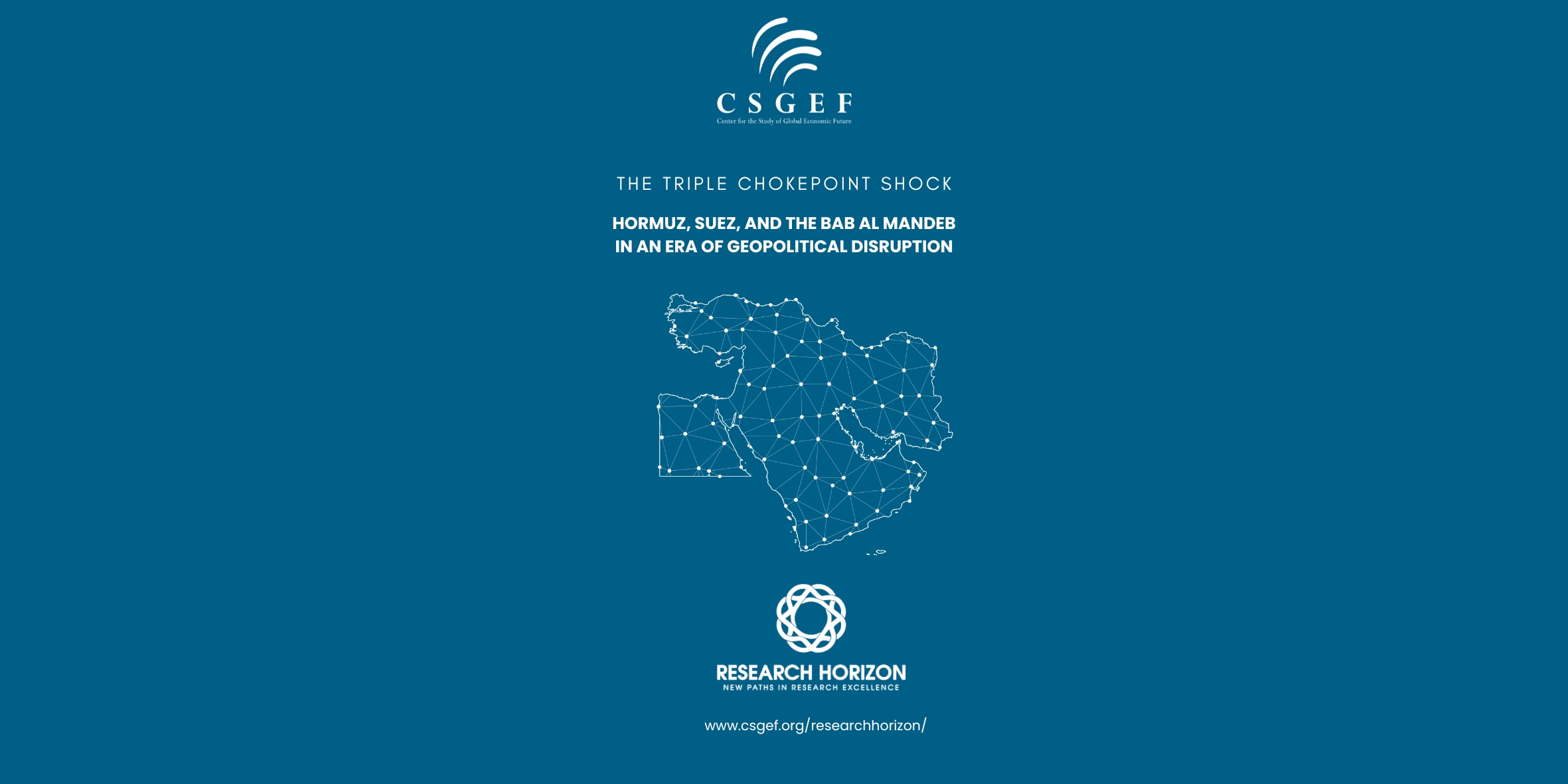
The Triple Chokepoint Shock: Hormuz, Suez, and the Red Sea in an Era of Geopolitical Disruption
Three of the most important maritime routes in the world — the Strait of Hormuz, the Red Sea corridor, and the Suez Canal — have experienced a rare and significant "triple chokepoint shock" as a result of the confrontation between Israel and Iran that broke out in late February 2026…
Read MoreSection 01 · Summary
Executive Summary
S as a result of the confrontation between Israel and Iran that broke out in late February 2026. Collectively, these routes support a significant portion of the world's containerized trade and energy movements. Their simultaneous disruption signifies a systemic shock to global supply chains, trade efficiency, and pricing stability in addition to a regional security crisis.
A crucial route for about one-fifth of the world's oil supply, the Strait of Hormuz has seen increased security risks, which have limited tanker traffic and increased insurance costs. Major shipping lines have been compelled to divert ships around the Cape of Good Hope due to growing attacks and instability in the Red Sea. This has resulted in significantly longer transit times as well as higher fuel and operating expenses. One of the most significant economic routes between Asia and Europe has been undermined as a result of this diversion, which has decreased traffic volumes through the Suez Canal.
Due to the combined impact of these disruptions, freight costs have sharply increased, supply schedules have been widely delayed, and the world's commodity markets — especially those for oil, gas, and necessities — have become more volatile. In addition to stressing supply chain dependability for businesses that depend on just-in-time operations, these constraints are raising the danger of inflation, particularly in nations that rely heavily on imports.
Geopolitically, the triple chokepoint shock underscores the growing interdependence between regional conflicts and global economic stability. The convergence of military tensions, non-state actor threats, and strategic rivalries has amplified maritime insecurity, exposing vulnerabilities in existing trade infrastructure and governance mechanisms. If prolonged, these disruptions could accelerate structural shifts in global trade routes, energy sourcing strategies, and geopolitical alignments.
Policymakers and industry stakeholders must respond with a multi-pronged approach. Stabilising insurance systems, improving naval coordination, and guaranteeing maritime security are crucial in the near term. Strengthening strategic reserves, investing in robust logistics infrastructure, and diversifying trade routes will be crucial over the medium term. In the long run, maintaining the integrity of international commerce routes will require coordinated international governance frameworks and conflict de-escalation initiatives. In the end, the triple chokepoint shock is a clear reminder that localised conflicts can quickly turn into worldwide economic disruptions in a time of geopolitical fragmentation. Maintaining stability in an increasingly interconnected global economy will require strengthening resilience against such systemic shocks.
Section 02 · Scenario Analysis
Scenario Matrix
This research is closely aligned with CSGEF's mission to provide rigorous, policy-relevant analysis of geopolitical disruptions and their global economic consequences. The scenario matrix below models outcomes across three trajectories — escalation, containment, and de-escalation.
| Variable | Escalation | Containment | De-escalation |
|---|---|---|---|
| Trade Volume | Severe Decline: 50% reduction in Suez throughput (Hamed, The Impact of the Red Sea Crisis on Global Shipping and Strategic Supply Chain Management, 2025) | Partial Decline: Transits fall to 35–40% of 2023 volumes (Roberto Rivas Hermann N. L., Arctic transshipment hub planning along the Northern Sea Route: A systematic literature review and policy implications of Arctic port infrastructure, 2022) | Recovery: Normal transit volumes restored (César Ducruet M.-A., 2025) |
| Freight Costs | Extreme Increase: Tripling of rates on major routes (Hamed, 2025) | Moderate Increase: 124% to 282% surge in indices (Kevin Cullinane, 2024) | Normal: Reversion to historical seasonal averages (Capili, 2023) |
| Transit Time | +10–14 days: Systemic rerouting via Cape route (Hamed, 2025) | Moderate Delays: Selective rerouting for risk-sensitive vessels (Dawar & Bai, 2024; Yap & Yang, 2024) | Normal: Standard transit schedules resume |
| Rerouting | Extensive: 77% or higher route deviation rates (Bai, 2024) |
Rerouting Extensive: 77% or higher route deviation rates (Bai, 2024) Selective: 74% increase in Cape routing observed (Roberto Rivas Hermann N. L., 2022) Minimal: Conventional shipping lanes used |
Minimal: Conventional shipping lanes used |
| Supply Chain | Severe Disruption: Systemic $1M/trip fuel surcharges (Roberto Rivas Hermann N. L., 2022) | Manageable Stress: Robustness of infrastructure prevents total failure (Chen, 2025) | Stabilization: Recalibration of trade routes and dependencies (César Ducruet M.-A., 2025) |
| Oil Prices | Sharp Increases: Strategic strikes on key infrastructure (Liu, 2025) | Modest Increases: Localized military engagements (Liu, 2025) | Stabilization: Returns to fundamental demand-supply levels |
Section 03 · Recommendations
Actionable Steps
The policy recommendations are based on The Triple Chokepoint Shock: Hormuz, Suez, and the Red Sea in an Era of Geopolitical Disruption. To address the systemic vulnerability exposed by simultaneous disruptions in Hormuz, Suez, and the Red Sea, policy responses must shift from reactive crisis management to structured resilience-building across three priority domains:
Immediate Maritime Security Coordination
States with strategic interests in these chokepoints should institutionalize joint naval patrols and convoy mechanisms, particularly in high-risk corridors such as the Red Sea. Existing ad hoc coalitions must be formalized into standing multilateral security arrangements with clear rules of engagement and burden-sharing mechanisms.
Strategic Diversification of Trade and Energy Flows
Overreliance on a narrow set of maritime passages must be reduced through:
- Expansion of alternative shipping corridors (e.g., Cape of Good Hope routing capacity)
- Investment in overland and multimodal logistics networks
- Decentralization of energy infrastructure, including regional storage and diversified sourcing
This reduces systemic exposure to synchronized chokepoint failures and limits cascading supply chain disruptions.
Integrated Risk Monitoring and Early Warning Systems
Governments and industry actors should co-develop real-time maritime risk intelligence platforms combining:
- Satellite surveillance
- AIS shipping data
- AI-driven disruption forecasting
These systems must be embedded in cross-national information-sharing agreements to ensure rapid dissemination of threat assessments.
Crisis Response and Continuity Frameworks
A formal multilateral maritime contingency protocol should be established to coordinate responses to chokepoint closures, including:
- Pre-negotiated rerouting agreements
- Emergency fuel and cargo prioritization mechanisms
- Standardized insurance and liability frameworks
This would significantly reduce response time and economic uncertainty during disruptions.
Legal and Institutional Reinforcement of Freedom of Navigation
States must strengthen commitment to freedom of navigation principles through updated international agreements that address hybrid threats, including non-state actors and asymmetric maritime warfare.
Get Involved
Download, Connect, or Contribute
Access the full research paper, reach out to our team, or submit your own research to the CSGEF network. We welcome collaboration from policymakers, academics, and industry professionals.
About the Research
Geopolitical Risk & Global Trade Analysis
Center for the Study of Global Economic Future (CSGEF)
Research & Collaboration
Connect with Research Horizon
Have questions, ideas, or research cooperation opportunities? Let CSGEF Research Horizon make the connection seamless for you!
Email us at research@csgef.org and we'll gladly facilitate your outreach.
CSGEF Publications · Research Horizon
Submit Your Research Paper Proposal
Contribute to CSGEF's mission of fostering a secure, peaceful, and prosperous global economic future. Submit your research paper proposal aligned with one or more of our thematic focus areas.
Click to attach files
CV, prior publications, or other supporting documents
Proposal Submitted
Thank you for contributing to CSGEF's Research Horizon. Our editorial team will review your proposal and be in touch within 5–7 working days.