Overview
Few questions in contemporary strategic analysis carry greater consequence than this one: what drives Russia's war in Ukraine? The answer shapes how analysts forecast Russian conduct, how governments calibrate deterrence, and how policymakers judge whether any durable settlement is possible.
This CSGEF poll examines a central strand of that debate: whether Russia's conduct is best explained by a historically rooted Eurasian identity, or by a more recent ideological construct promoted by the Kremlin. The poll draws on three scholarly contributions that approach the question from distinct vantage points. Together, they show how historical interpretation, ideology, and strategic theory compete to explain one of the most consequential conflicts of the twenty-first century.
Work through the tabs for the background, then share your assessment in the poll.
The Article and Its Central Argument
In her September/October Foreign Affairs article, "The Myth of Eurasia," Ayşe Zarakol examines Russia's imperial mindset in the context of the war in Ukraine. Zarakol is Professor of International Relations in the Department of Politics and International Studies at the University of Cambridge.
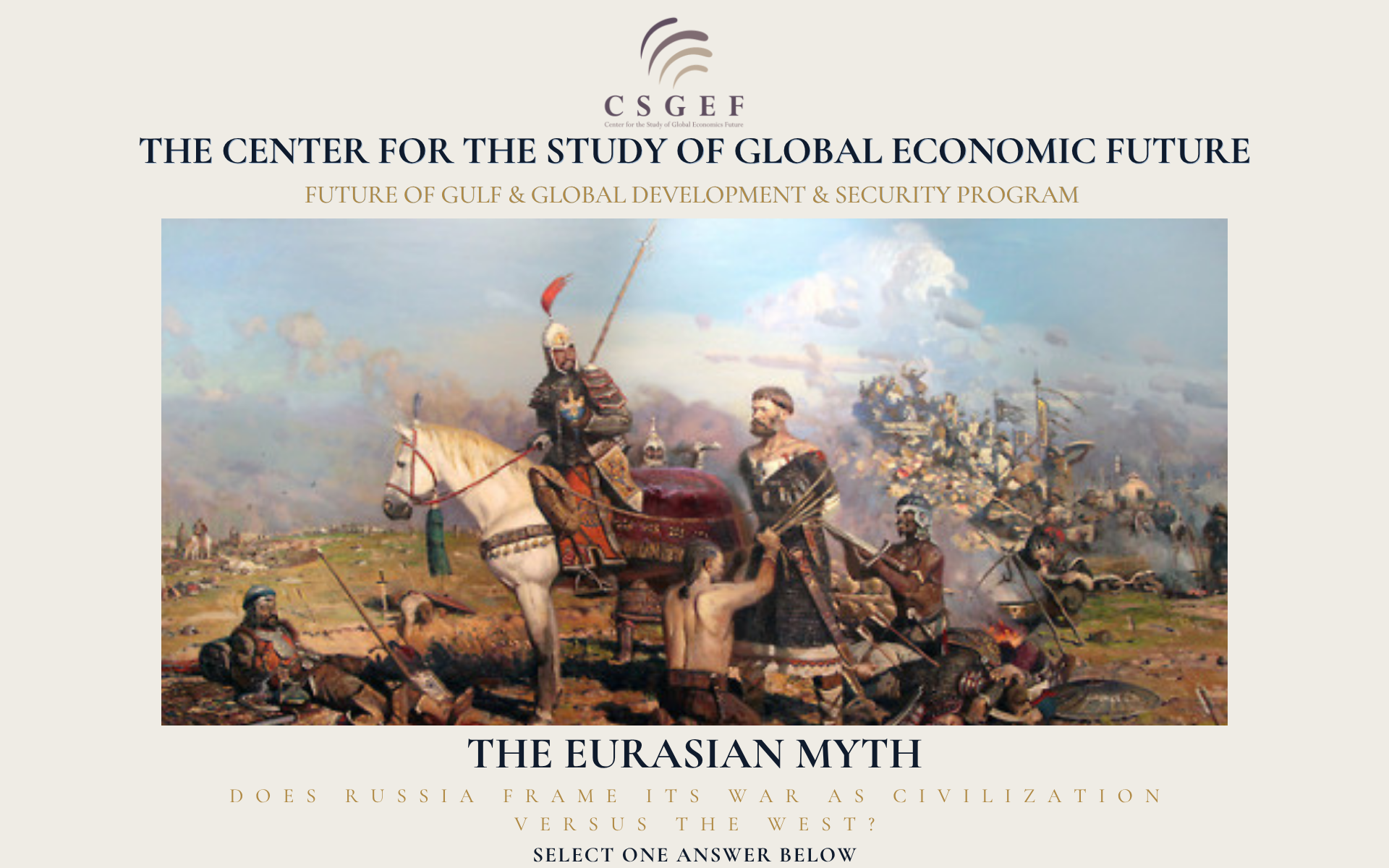
Zarakol develops her argument through a discussion of a major recent work of Russian imperial history: Mikhail Khodarkovsky's The Steppe and Its Empires: The Russian Empire and Its Eurasian Rivals. Her review places the book's historical findings in direct conversation with present-day strategic questions. In doing so, it asks how far the concept of "Eurasia" truly explains Russian behavior, and how far it serves as a convenient narrative.
AZ
Ayşe Zarakol
Professor of International Relations, Department of Politics and International Studies (POLIS), The University of Cambridge
The Book and Its Author
Mikhail Khodarkovsky is a historian of the Russian Empire and Professor of History at Loyola University Chicago. He is also an affiliated scholar and visiting professor at the Center for East European and Russian/Eurasian Studies at the University of Chicago.
The Steppe and Its Empires offers a broad comparative study of the Eurasian steppe and its influence on the trajectory of Russian history. Its analysis sheds light on several themes that bear directly on the current war:
- Cultural framing of the conflict. Russia portrays its invasion as a cultural struggle against Western influence.
- "Civilizational diversity." Moscow invokes this concept to reject the universality of Western liberal norms.
- Distinctive identity. Official discourse emphasizes a uniquely Russian identity, separate from Europe.
- Eurasianism as historical legacy. In this account, Eurasianism supplies a lineage that separates Russia from Western liberal traditions.
Khodarkovsky highlights genuine historical and cultural differences between Russia and Western Europe. At the same time, he cautions against overly simplistic interpretations of Russian conduct. His broader argument calls for a precise, evidence-based understanding of contemporary geopolitical realities rather than reliance on sweeping civilizational narratives.
"His broader argument calls for a precise, evidence-based understanding of contemporary geopolitical realities rather than reliance on sweeping civilizational narratives."
MK
Mikhail Khodarkovsky
Professor of History, Loyola University Chicago
A Competing Interpretation
Gergely Egedy, a Hungarian historian, political scientist, and professor at the University of Public Service, also rejects the Eurasian framework, but for a different reason.
Egedy argues that the war arises from the Kremlin's ideology of the "civilizational state," rather than from a historically rooted Eurasian identity. The distinction is significant. Where the Eurasian framework locates the source of Russian conduct in deep historical and geographic continuity, Egedy points to a deliberate, contemporary ideological project shaped and advanced by the Russian leadership.
"Where the Eurasian framework locates the source of Russian conduct in deep historical and geographic continuity, Egedy points to a deliberate, contemporary ideological project."
Egedy also engages with the realist school. In his view, John Mearsheimer's realist interpretation, which emphasizes great-power security competition and structural pressures, is insufficient on its own. The logic of Russia's offensive, he contends, must also be understood through this ideological lens.
GE
Gergely Egedy
University of Public Service
JM
John Mearsheimer
Realist school
Three Lenses on a Single Conflict
The debate reflects a broader methodological divide in the study of strategy and international relations. Each lens carries different implications for analysis and policy.
These lenses are not mutually exclusive. Much of the most rigorous scholarship weighs how historical legacy, ideology, and structural pressure interact. The analytical stakes, however, are considerable. Treating an ideological construct as an immutable civilizational trait risks overstating continuity. Conversely, dismissing history entirely risks overlooking the narratives that legitimize state action at home.
"Treating an ideological construct as an immutable civilizational trait risks overstating continuity."