







Understanding the Tangible Effects of Public Policy
Understanding the tangible effects of public policy demands more than raw statistics — it requires rigorous visual analysis. As part of our mission to provide in-depth analysis of economic and geopolitical research, CSGEF has developed Policy Impact Graphs.
These sophisticated visualizations transform complex, multi-layered policy data into clear, strategic insights for policymakers, academics, and national security experts.
By utilizing comparative bar charts and detailed time-series data, we help you measure the direct outcomes of specific public policy interventions — enabling strategic planning based on concrete evidence rather than assumption.
"Evaluating government interventions often involves navigating dense reports and fragmented statistics. Our Policy Impact Graphs resolve this challenge by translating intricate data into precise visual formats."
Key Features and
Strategic Benefits
Comparative Intervention Analysis
Evaluate multiple policy scenarios side-by-side. Our comparative bar charts isolate critical variables, helping you identify which interventions yield the most substantial socioeconomic benefits across different regions or sectors.
Historical Time-Series Tracking
Monitor the evolution of policy effects over extended periods. Our time-series data reveals long-term behavioral and economic trends, ensuring you understand the sustained impact of legislative shifts — not just immediate reactions.
Data-Driven Strategic Insights
Move from abstract numbers to authoritative strategy. We distill complex geoeconomic and political data into streamlined visual evidence that supports robust, confident decision-making at every level.
Featured Policy Impact
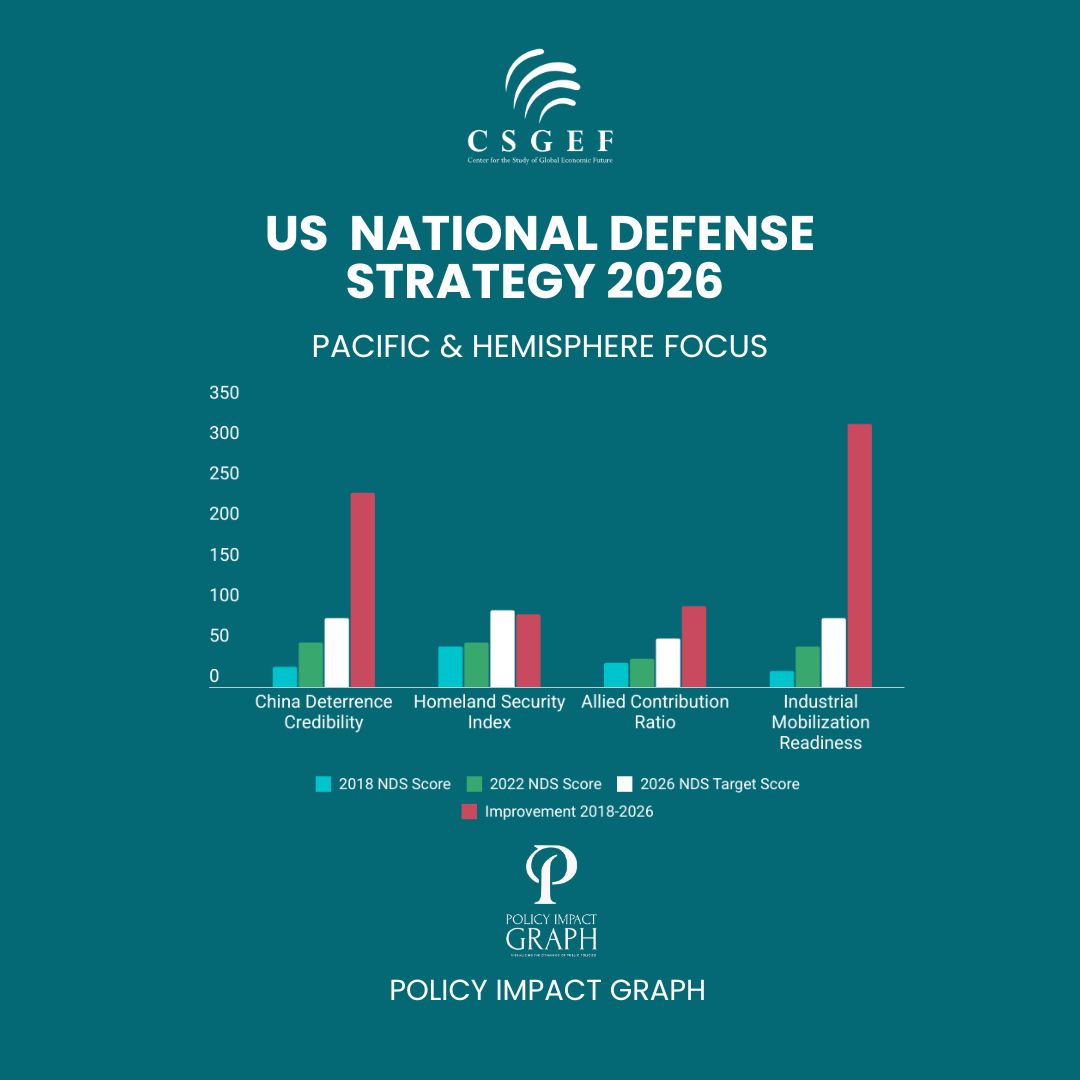
2026 National Defense Strategy — Pacific & Hemisphere Focus
This analysis examines the strategic resource allocation and measurable capability outcomes of the 2026 U.S. National Defense Strategy, benchmarked against the 2018 and 2022 NDS frameworks. By mapping pre- and post-intervention data across four key performance domains — China Deterrence Credibility, Homeland Security Index, Allied Contribution Ratio, and Industrial Mobilization Readiness — CSGEF's Policy Impact Graphs reveal the strategic logic and measurable consequences of America's most significant defense posture shift in a generation.
- +325% Industrial Mobilization Readiness improvement — the highest gain across all metrics, reflecting urgent lessons from supply chain disruptions and wartime production shortfalls
- 45% resource allocation to Homeland Defense & Western Hemisphere — establishing direct territorial control and regional dominance as the organizing priority of U.S. defense strategy
- 30% risk reduction in Hemisphere Partnership (7.3 → 5.1/10) — driven by bilateral agreements, intelligence sharing, and Trump Corollary activation
- Significant Golden Dome Readiness improvement (8.7 → 6.4 risk score) — reflecting accelerated missile defense capability deployment by 2026
Featured Policy Impact
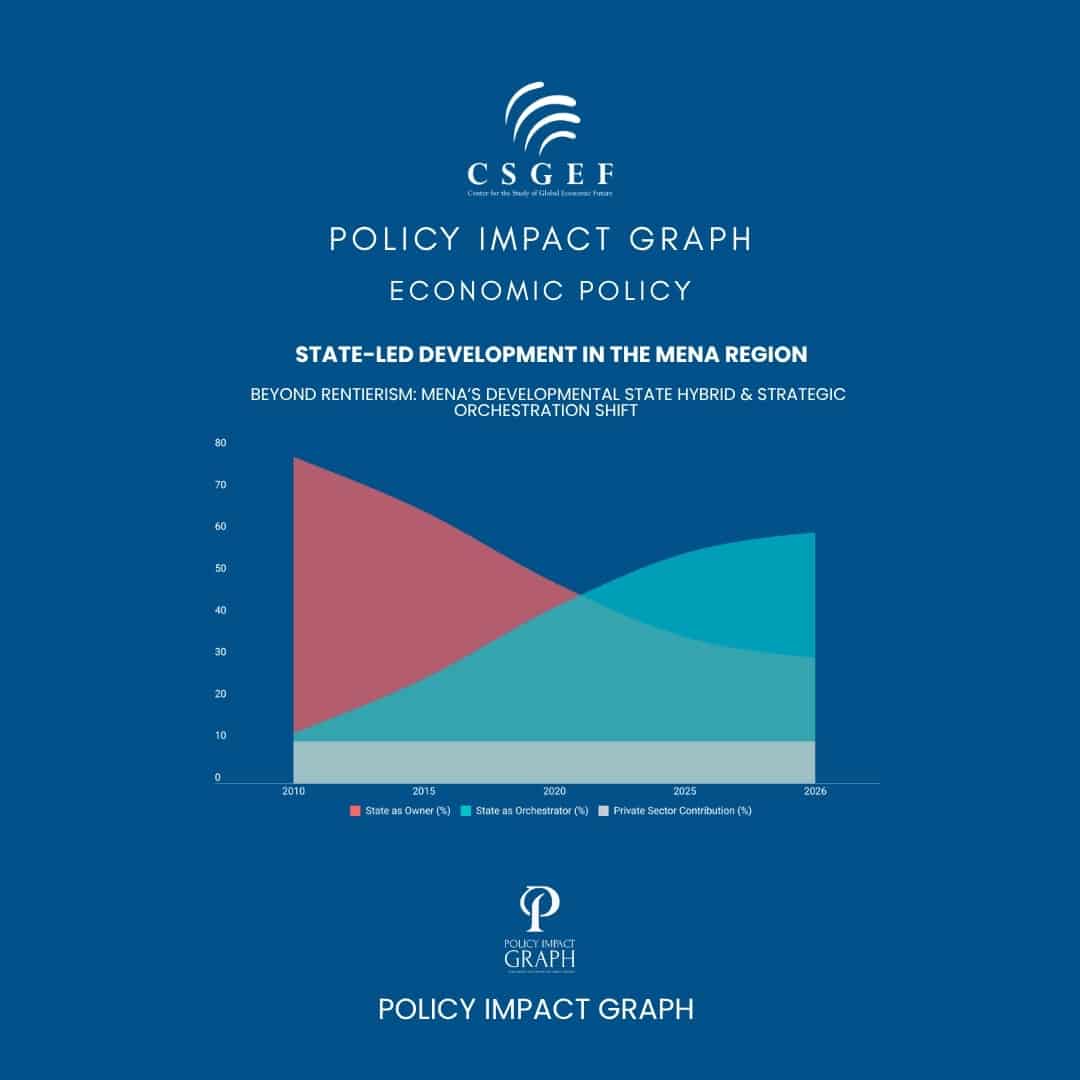
State-Led Development in the MENA Region — Beyond Rentierism: How Strategic State Orchestration Is Reshaping MENA's Economic Future
This visual analysis examines the strategic institutional evolution and measurable economic outcomes of state-led development in the MENA region, benchmarked against historical dirigiste, market-led, and peer global frameworks. By mapping pre- and post-intervention data across four key performance domains — State Role Transformation, Economic Diversification Uplift, Regional Orchestrator Leadership, and Institutional Trade-off Calibration — CSGEF's Policy Impact Graphs reveal the strategic logic and measurable consequences of the region's most significant economic governance shift in decades.
- +39 percentage point total policy-attributable uplift — the highest quantified gain from adopting the Developmental State Hybrid model, reflecting the measurable impact of active state-directed diversification over historical rentier and pure market frameworks
- 48-percentage-point institutional inversion in the UAE (State Ownership: 78% → 30%; State Orchestration: 12% → 60%) — establishing strategic steering over direct asset control, with private sector contribution held steady at 10% to confirm sovereign reconfiguration rather than market liberalization
- GCC regional orchestrator leadership established by 2020 — surpassing North Africa and the Levant through sovereign wealth pivots, regulatory innovation, and centralized technocratic execution, widening the orchestration lead to 11 points by 2026
- "Orchestration 2.0" — The developmental state profile achieves a high mean institutional score of 7.72/10 (anchored by Social Protection, State Role, and Resilience)
Command the Data
Empower your research and strategic thinking with precise, authoritative data visualization. Our tools convert complex geoeconomic and political data into actionable intelligence.
Empower Your Research
Explore our Policy Impact Graphs today to gain an in-depth analysis of global policy interventions and turn complex information into a decisive strategic advantage.
Explore Policy Impact Graphs