
CSGEF · Policy Impact Graph
Defense & Security Policy Impact Graph
Military Capability, Procurement & Strategic Force Posture — Quantifying outcomes of defense interventions with comparative & time-series rigor across procurement, doctrine, alliance commitments, and strategic deterrence.
Overview
Understanding the tangible effects of defense policy demands rigorous visual analysis. The Defense & Security Policy Impact Graph measures defense procurement decisions, military capability investments, and security cooperation agreements against quantifiable outcomes. We track these interventions to determine their direct impact on force readiness, interoperability, and strategic deterrence credibility.
This domain focuses on aligning force structure, procurement, doctrine, and alliance commitments toward defined national security objectives across both peacetime and contingency environments. We translate intricate defense data into precise visual formats for policymakers, defense analysts, and national security experts.
Spotlight
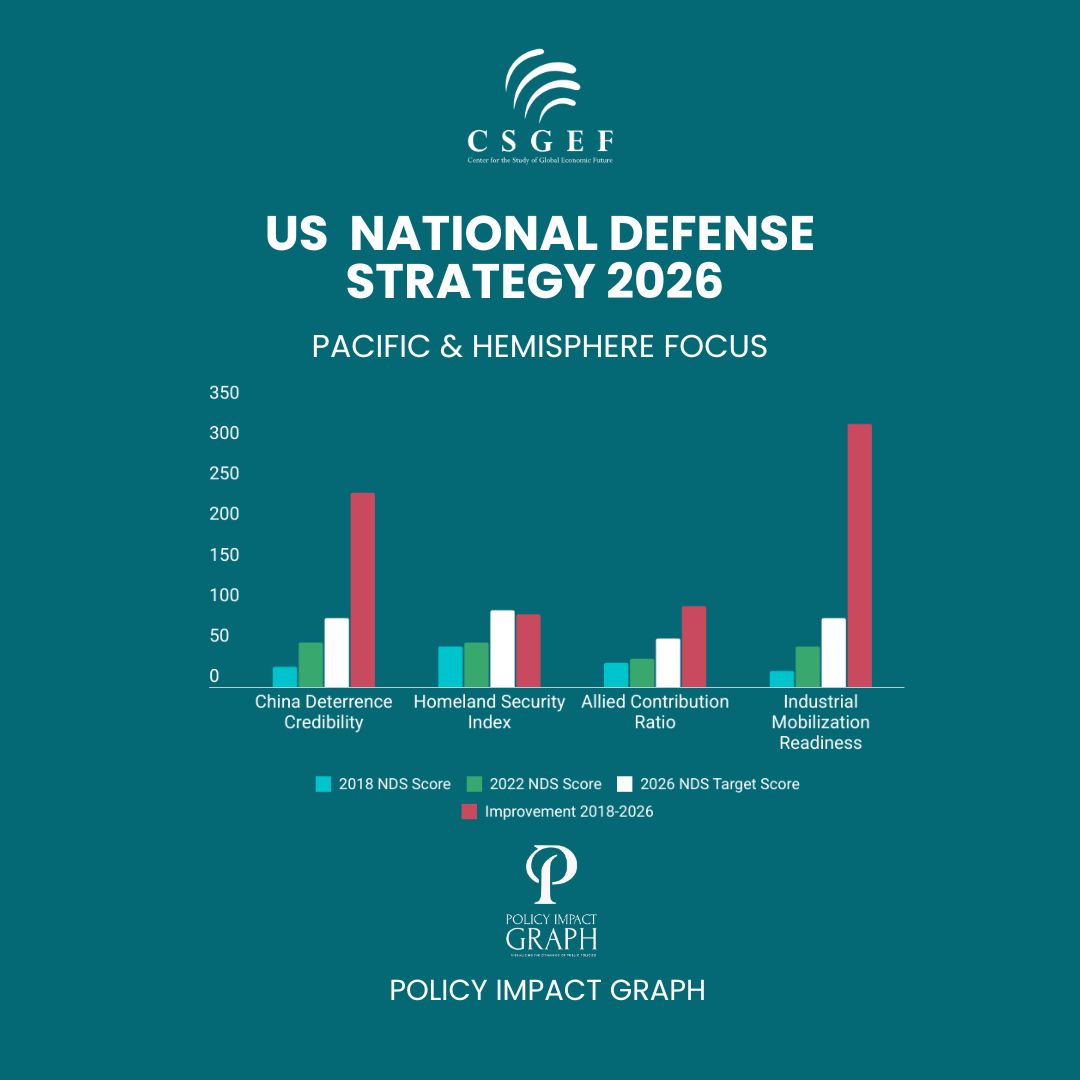
2026 National Defense Strategy — Pacific & Hemisphere Focus
This analysis examines the strategic resource allocation and measurable capability outcomes of the 2026 U.S. National Defense Strategy, benchmarked against the 2018 and 2022 NDS frameworks. By mapping pre- and post-intervention data across four key performance domains — China Deterrence Credibility, Homeland Security Index, Allied Contribution Ratio, and Industrial Mobilization Readiness — CSGEF's Policy Impact Graphs reveal the strategic logic and measurable consequences of America's most significant defense posture shift in a generation.
Methodology
Key Methodological Features
Evaluating defense interventions involves navigating dense procurement reports and fragmented capability statistics. We resolve this challenge by applying three core methodologies:
Comparative Intervention Analysis
Evaluate multiple defense policy scenarios side-by-side. Our comparative bar charts isolate critical variables, identifying which procurement or doctrinal interventions yield the most substantial security benefits across different branches or strategic theatres.
Historical Time-Series Tracking
We monitor the evolution of defense policy effects over extended periods. Time-series data reveals long-term capability trends, ensuring you capture the sustained impact of modernization shifts beyond immediate budget cycles.
Data-Driven Strategic Insights
We move from abstract numbers to authoritative strategy. Our framework distills complex military and procurement data into streamlined visual evidence, supporting robust and confident defense decision-making.
Focal Policy Domains
Ten primary sub-domains within the defense and security landscape:
Domain 01
Defense Policy & Strategy
Evaluates the coherence of a state's overarching defense framework — aligning force structure, procurement, doctrine, and alliance commitments toward defined national security objectives across peacetime and contingency environments.
Domain 02
Force Structure & Modernization Strategy
We evaluate long-cycle defense modernization programs against force readiness, capability gap closure, and strategic balance outcomes.
Domain 03
Defense Industrial Base Policy
We track domestic defense production capacity, supply chain resilience, and industrial mobilization policy against wartime and peacetime benchmarks.
Domain 04
Security Sector Reform Impact
We measure security sector reform program effectiveness in post-conflict and fragile state contexts against professionalization, civilian oversight, and operational capability metrics.
Domain 05
Emerging Domain Warfare Policy
We track policy frameworks for space, cyber, and electromagnetic spectrum operations against capability development and operational readiness benchmarks.
Domain 06
Defense Technology Transfer Policy
We evaluate arms export controls, co-production agreements, and technology transfer frameworks against alliance cohesion and proliferation risk.
Domain 07
Defense Budget Allocation Efficiency
We analyze defense expenditure portfolios — personnel, procurement, R&D, and operations — against capability outcomes per dollar invested.
Domain 08
Interoperability & Coalition Warfare
We evaluate multinational exercise policy and joint doctrine development against real-world coalition interoperability performance.
Domain 09
Military Manpower & Recruitment
We assess conscription, voluntary service, and reserve policy outcomes against force generation targets and demographic sustainability.
Domain 10
Arms Control Compliance
We monitor adherence to arms limitation treaties and confidence-building measures against escalation risk and verification outcomes.
Visual Elements & Interactive Data
Advanced visual analytical tools precisely mapped to each focal area:
Comparative Procurement Dashboards
Interactive bar and column charts present side-by-side comparisons of procurement timelines and budget allocations, highlighting which investment strategies generate the most significant shifts in force readiness and capability.
Historical Readiness Time-Series
Multi-layered line graphs chronicle longitudinal data on modernization cycles, force generation, and capability gaps — visualizing how unit readiness and technological parity evolve in response to specific policy actions.
Interoperability and Alliance Matrices
Network graphs and burden-sharing maps illustrate the architecture of coalition warfare, detailing patterns of joint exercises, equipment commonality, and operational integration across allied forces.
Strategic Posture Heatmaps
Geospatial heatmaps capture the real-time and historical distribution of military assets, basing agreements, and mobilization capacity — offering granular insight into power projection and deterrence credibility.
Custom Capability Simulations
Interactive modules allow you to model the potential impact of alternative defense scenarios — adjusting budget distributions, technology transfers, or manpower policies to forecast downstream effects on strategic deterrence and force structure.
About the Research

Policy Impact Graph · Defense & Security Analysis
Center for the Study of Global Economic Future (CSGEF)
Research & Collaboration
Connect with Policy Impact Graph
Have questions, ideas, or research cooperation opportunities? Let CSGEF Policy Impact Graph make the connection seamless for you!
Email us at research@csgef.org and we'll gladly facilitate your outreach.